

For many people, the morning newspaper is no longer a physical newspaper. It is a phone screen, a laptop tab or an app notification that appears before breakfast. News has become faster and easier to access, but that convenience has also created a problem: there is now so much information available that it can be difficult to decide what is actually worth reading.
That is where a paid newspaper subscription can still make sense. Instead of jumping between social media posts, free websites and short news updates, some readers prefer having access to a publication they can return to every day. The Hindu is one of the newspapers that continues to attract this kind of reader, particularly people who prefer detailed reporting, analysis and longer articles rather than headlines alone.
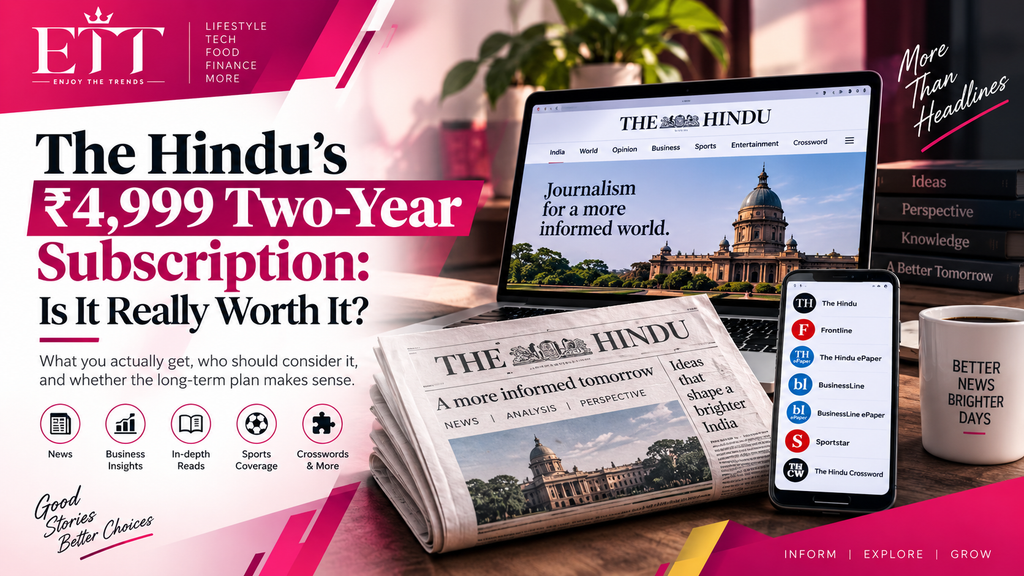
The current All Access Pass highlighted in the offer takes that idea further. The advertised plan is a two-year subscription priced at ₹4,999, with a displayed regular price of ₹5,999. The package brings several publications and digital products together rather than limiting the reader to The Hindu alone. The material provided for this review lists The Hindu, Frontline, The Hindu ePaper, The Hindu BusinessLine, BusinessLine ePaper, Sportstar and The Hindu Crossword as part of the package.
That sounds like a substantial amount of content, but the real question is not how many publications appear on the subscription page. The more useful question is whether a normal reader will actually use them. A subscription can look impressive on paper and still be poor value if most of its features remain untouched.
What The Hindu’s All Access subscription is really offering
The simplest way to look at the All Access Pass is as a broader digital reading package rather than just an online newspaper subscription.
The Hindu remains the main attraction for most readers, but the package extends beyond general news. Frontline adds a long-form magazine perspective, BusinessLine focuses on business and economic coverage, Sportstar caters to sports readers, and the ePaper editions provide a more traditional newspaper-reading experience in digital form. The Crossword adds another kind of content altogether.
The Hindu Group itself lists The Hindu, BusinessLine, Sportstar, Frontline and the respective ePaper products among its publications and digital offerings. Its official terms page also identifies websites and services covering these publications, including The Hindu, BusinessLine, Sportstar, Frontline, the two ePaper platforms and Crossword.
That variety is important because different readers use newspapers for different reasons. Someone preparing for an examination may be interested in national affairs and economics. A working professional might spend more time with business coverage. Another reader may open Frontline on the weekend because they prefer longer articles. A sports fan could have an entirely different reason for subscribing.
The value of the package therefore depends heavily on how broad your reading habits are.
₹4,999 sounds expensive until you look at the duration
The first reaction to a ₹4,999 price tag may be that it is expensive for a newspaper subscription. That reaction is understandable, especially when so much news is available for free.
However, the subscription lasts for two years. Dividing ₹4,999 across 24 months brings the average cost to approximately ₹208 per month, or around ₹2,500 per year.
That makes the offer easier to understand, although the calculation should not be used as a sales trick. Paying ₹208 per month on paper does not automatically mean you are getting good value. You are still committing nearly ₹5,000 upfront, and the subscription is useful only if you actually use it.
This is particularly important with digital subscriptions. People often sign up because an offer is discounted, use the service heavily for a few weeks and then gradually stop opening it. By the time the subscription is remembered again, months may have passed.
In that situation, even a relatively cheap subscription becomes expensive.
The displayed offer shows a reduction from ₹5,999 to ₹4,999, representing an advertised saving of ₹1,000. But consumers should be careful about looking at the discount as the main reason to purchase. You have only saved ₹1,000 if you were actually going to buy the subscription at the original price.
Otherwise, you have simply spent ₹4,999 instead of ₹5,999.
The biggest advantage is the range of content
The most convincing part of the All Access Pass is the combination of publications.
A reader who only wants The Hindu may not need an all-access package. But someone who reads different kinds of content throughout the week could get much more from the bundle.
A typical reader might start the day with The Hindu for general news and analysis, check BusinessLine later for business developments, read a Frontline article over the weekend and turn to Sportstar when following a major sporting event. Someone else might use the ePaper regularly because they prefer reading the newspaper as a complete edition rather than opening individual articles.
That is where the subscription starts to feel less like paying for a website and more like paying for a digital library of publications.
The Hindu Group’s own privacy and publication information describes BusinessLine as available in print, web and ePaper formats, while Frontline is a fortnightly magazine and Sportstar is a fortnightly sports magazine available in print and web formats. The group also produces e-books, podcasts, videos and other multimedia content.
The important point, however, is that access does not equal usage.
If you never read BusinessLine, its inclusion does not add much personal value. If you are not interested in sports, Sportstar may mean very little to you. If you never use an ePaper, having access to one will not suddenly make the subscription more useful.
A bundle is valuable because of what you use, not because of how long the feature list looks.
Why the ePaper still matters
There is something different about reading an ePaper compared with browsing a news website.
Online news is designed to keep you moving. You read one story and immediately see another headline. A related article appears below it. A notification arrives. You open another tab. Social media is only a click away.
An ePaper provides a little more structure.
It allows readers to move through an edition in a way that resembles reading a physical newspaper. The format can encourage people to explore different sections instead of reading only the stories that an algorithm has placed in front of them.
For people who grew up with newspapers, that experience can still be appealing. It is also useful for readers who want a more deliberate morning routine.
The Hindu’s digital ecosystem has long included ePaper products, and its official group information lists both The Hindu ePaper and BusinessLine ePaper among its services.
This does not make the ePaper automatically better than the website. It simply gives readers another way to consume the same broader news offering.
BusinessLine adds a different kind of reading
One reason the All Access Pass can appeal to professionals is BusinessLine.
General news and business news often overlap, but they serve different reading purposes. A general news report may explain what happened, while business-focused coverage can spend more time looking at companies, industries, markets, policy and the economic consequences of events.
That makes BusinessLine potentially useful for entrepreneurs, professionals, investors, business students and anyone who follows India’s economy closely.
It is also one reason students preparing for competitive examinations may find a wider news package useful. Current affairs often require understanding the background behind economic and policy developments rather than memorising isolated headlines.
But again, readers should not confuse access with preparation.
Buying a newspaper subscription will not prepare someone for an examination by itself. The useful part is the habit that comes afterward: reading consistently, understanding the context and making notes when necessary.
Frontline is for readers who want more context
The inclusion of Frontline gives the subscription a different character.
Short news articles are useful when you need to know what happened quickly. Longer articles serve another purpose. They allow writers to spend more time explaining the background, examining different aspects of an issue and developing a larger narrative.
That can be useful for readers who feel that the constant stream of breaking news leaves them informed about events but not necessarily informed about the subjects behind those events.
The Hindu Group describes Frontline as a fortnightly magazine available in print and web formats.
For someone who enjoys long-form journalism, that can be an important reason to consider the broader subscription.
For someone who only wants quick updates, it may be one of the least-used parts of the package.
Students may get more out of it than casual readers
Students are another group for whom regular newspaper reading can become valuable.
A student following current affairs can encounter subjects ranging from government policy and international relations to economics, science, social issues and business. Reading about those subjects regularly can make it easier to understand how different issues connect.
There is also a language benefit to sustained reading, although that should not be exaggerated. Reading well-written English regularly can expose a reader to vocabulary, sentence structures and different ways of presenting an argument.
The Hindu’s wider educational ecosystem includes STEP, an English-learning platform that provides personalised learning content and one-on-one coaching. Its current website says the platform has impacted more than three million learners and offers learning through video lessons, phone calls with trainers and live classes.
The existence of STEP does not mean the All Access Pass should be treated as an English-learning course. They are separate products. But it does show that The Hindu’s ecosystem extends beyond traditional newspaper publishing.
For a student, the newspaper itself can simply become part of a broader learning routine.
The two-year commitment is the part I would consider carefully
There is one obvious downside to the offer: two years is a long time.
People often underestimate how much their habits change.
You may have plenty of time to read now and much less six months later. You may start a new job. You may change your preferred news sources. You may discover that you prefer watching news videos instead of reading articles.
That is why the two-year plan is more attractive to an existing reader than to someone experimenting with The Hindu for the first time.
If you already read the publication regularly, you have evidence that you are likely to use it.
If you do not currently have that habit, buying two years in advance is more of a gamble.
The smarter approach is to judge your actual behaviour rather than your intentions.
It is easy to say, “I will read the newspaper every morning.”
It is much harder to do it for 700-plus mornings.
What about the extra accounts?
The subscription material also shows an option for an All Access Pass with two extra accounts, described as an option to share with friends or family.
That could make the package more attractive for a household where several people genuinely want to read.
One person might prefer general news, another might follow business, while someone else may be more interested in sports. If the current subscription terms allow the accounts to be used in the way a household needs, the cost can effectively be spread across multiple readers.
However, this is exactly the kind of feature where you should read the current terms before paying.
The promotional description alone should not be treated as a complete explanation of account-sharing rules. Check how additional accounts are created, who is eligible to use them and whether there are restrictions on devices or locations.
A subscription is not a good deal if its most attractive feature turns out not to work the way you expected.
Paying for news is not automatically better than reading free news
There is an important misconception worth clearing up.
Paying for journalism does not mean everything behind a paywall is automatically better.
Free journalism can be excellent. Paid journalism can be mediocre. Readers should evaluate information based on its quality rather than assuming that price is proof of accuracy.
The reason to pay is more practical.
Professional journalism requires resources. Reporters investigate stories, editors work on them, photographers and videographers document events, and technology teams publish the final product across different platforms.
The Hindu’s digital history is also significant. WAN-IFRA reported that The Hindu Group was the first English-language Indian newspaper to go digital in 1995 and later introduced a soft paywall in 2019 before moving to a metered model.
That history helps explain why paid digital access has become part of the newspaper’s business model.
For readers, the decision is ultimately personal. If you regularly consume the journalism and believe it provides enough value to justify the cost, a subscription can make sense.
If you do not use it, there is no reason to pay merely because other people consider the publication important.
Who is the ₹4,999 plan best suited for?
The strongest candidate is the regular newspaper reader who already knows that The Hindu is part of their routine.
For that person, the subscription is not an attempt to create a new habit. It is simply a way to pay for an existing one while gaining access to additional publications.
The second group is the serious current-affairs reader. People who regularly follow politics, economics, business, society and international affairs can potentially make better use of the wider package.
Students and professionals are another obvious audience, particularly those who read newspapers as part of their studies or work.
Finally, households that can legitimately make use of the additional accounts may find the subscription more attractive than an individual reader would.
The common factor is simple: these people are readers.
Who should probably skip the subscription?
Someone who rarely reads news probably does not need it.
The same is true for someone who gets all their information from short videos and social media and has no intention of changing that habit.
There is also little reason to buy the plan if ₹4,999 would put unnecessary pressure on your budget. A news subscription is useful, but it is not a financial necessity.
And if you are only interested because the offer displays a discount, take a step back.
The ₹1,000 saving is not the point. The question is whether the service is worth ₹4,999 to you.
That is a much better way to evaluate any subscription.
The verdict: good value for regular readers, unnecessary for everyone else
The Hindu’s ₹4,999 two-year All Access Pass is not a deal that I would recommend blindly to everyone.
It is a better proposition for readers who already have a habit of reading newspapers and who can make use of several publications included in the package. The combination of The Hindu, Frontline, BusinessLine, ePaper editions, Sportstar and Crossword gives the subscription considerably more breadth than a basic digital newspaper plan.
At roughly ₹208 per month over two years, the price can be reasonable when the subscription becomes part of a regular reading routine.
But if you are buying it because the promotional price looks attractive, that is not enough.
The two-year commitment means you should think beyond the first few weeks. Consider how often you currently read, which publications you would actually use and whether the subscription fits comfortably into your budget.
For someone who reads The Hindu every morning, follows BusinessLine, enjoys Frontline or regularly uses the ePaper, the package has a convincing case.
For someone who rarely reads long-form journalism, most of the bundle may simply go unused.
And that leads to the most important point about this subscription.
The value of a newspaper subscription is not measured by how much content you can access. It is measured by how much of that content becomes part of your life.
If The Hindu is already part of your routine, ₹4,999 for two years can be a reasonable investment in that habit.
If it isn’t, don’t buy the subscription hoping the purchase itself will make you a reader.
Buy it because you read. Not because the discount looks good.